


President of Russia Vladimir Putin: Colleagues, good afternoon.
Today, we will discuss matters concerning the development of one of the key sectors of Russia’s fuel and energy complex. The conversation will focus on nuclear energy, and the current and future goals for this strategic sector.
First and foremost, I would like to note that today marks 81 years since the establishment of Russia’s nuclear industry. On this important anniversary, I would like to extend my greetings to all industry veterans and employees. I would like to add that from the very first days of the atomic project, alongside addressing defence objectives, the peaceful applications of nuclear energy – in power generation, transportation, and other sectors – were given the utmost attention.
Today, the nuclear energy sector, with its tremendous concentration of scientific expertise, technology, state-of-the-art materials, manufacturing and construction solutions, and highly skilled professionals, is, without exaggeration, a source of pride for our country. Russia is perhaps the only country in the world to have competencies across the entire nuclear energy chain with a solid track record of upholding high safety standards and ensuring the reliable operation of nuclear power plants.
It is these competitive advantages that have made Russia a leader in building NPPs abroad. Today, Rosatom has 28 power units in its portfolio in various countries around the world.
Nuclear power generation has special importance for ensuring the stable operation of the domestic power grid. Its share in the national energy mix has been increasing. Today, nuclear energy accounts for about 20 percent of domestically produced electric power.
Long-term plans for this sector in Russia provide for launching about 30 gigawatts of nuclear generating capacity, including small NPPs. This will not only replace power units that are set to reach the end of their life cycle, but will also help substantially increase the overall nuclear power generation capacity.
Plans to build power units across a wider geography have special importance. The latest nuclear stations will be built in the Urals, Siberia and Russia’s Far East for producing affordable, clean energy.
This effort is designed to create a solid foundation for infrastructure development with a view to promoting long-term regional and territorial development and facilitating the emergence of new, energy-intensive production sites, including those specialising in the deep processing of natural resources in the Arctic, Siberia and Russia’s Far East, while also serving sectors and powering services which have been playing an increasingly important role in the present-day economy. I am referring to electric transport, industrial robotics, automation in the services sector, etc.
And, of course, that includes the development of artificial intelligence tools and the construction of data storage and processing centres. These elements of the digital, platform economy are driving growing demand for electricity. This demand must be calculated and planned for, and the necessary generating capacity must be provided, including, of course, from nuclear power plants.
In this regard, I would like to emphasise the following key points.
First. It is important to ensure technological readiness for the design and construction of nuclear power plants – both large and small – and to have a range of standard power units that can be assembled in series, on a production-line basis.
This means scaling up the manufacture of power engineering products based on domestic developments. Industry and related enterprises, research centres, and laboratories must be prepared for this.
Second. A vitally important task is ensuring that nuclear power plants have a sufficient fuel supply. Here, we must work to strengthen our own resource base, conduct geological exploration, and develop deposits.
Third. Competition in the global nuclear energy industry is fierce, and we must strengthen our technological leadership in this field, continually improve the safety of nuclear generation, and enhance its economic efficiency. Russia possesses the most advanced closed nuclear cycle technologies, which allow for the repeated use of fuel. We must ensure the widespread adoption of such technical solutions.
Fourth. The construction and maintenance of nuclear facilities clearly requires highly skilled personnel. Our national school of thought is strong in this area, but, I repeat, our competitors are also advancing rapidly. Therefore, we must maintain a high standard of training for relevant specialists – scientists, engineers, technicians, and managers – and provide opportunities for existing industry workers to continually upgrade their skills.
Fifth. Successfully implementing our plans in the nuclear energy industry requires a sustainable financial model for its growth. This model must take into account the specifics of financing investment projects, the scale of investment, payback periods, and so on.
Let us discuss all of these topics. Now, I give the floor to Rosatom Director General Alexei Likhachev.
Please, Mr Likhachev.
Director General of Rosatom State Corporation Alexei Likhachev: Mr President,
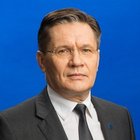
First of all, thank you very much for your warm greetings and kind words addressed to the entire nuclear industry and our large team. And, of course, thank you for your continued and unwavering support of Rosatom’s work, both in Russia and abroad.
Indeed, the Soviet nuclear project began 81 years ago. Our predecessors not only created the “nuclear shield and sword” in a remarkably short time, but also secured global leadership in peaceful nuclear energy. The year 1954 saw the first Obninsk NPP, followed by the nuclear icebreaker, small power plants, and fusion units. We are building on this legacy today – both in terms of our country’s energy supply and our competitiveness in the global market. This rests on scientific research, technological development, and, most importantly, the dedication of our massive workforce.
Let me now turn to the report. I would like to request, if possible, the use of the visual materials entitled “Development of Nuclear Energy in the Russian Federation.”
Nuclear energy in Russia today comprises 34 operating units at 11 nuclear power plants. These include the unique floating nuclear power plant Akademik Lomonosov with two reactor units, and six units of the Zaporozhye Nuclear Power Plant, which are currently in cold shutdown. Last year, we generated over 218 billion kilowatt-hours. Including our wind and thermal generation, we supplied the system with over 230 billion kilowatt-hours. This year, these figures will improve, and we are guaranteed to maintain our position as the largest power generating company in the country.
Our division is primarily the Rosenergoatom concern – the operator of all active nuclear power plants. It includes the Titan-2 construction holding company, numerous service and repair organisations, and employs approximately 88,000 people.
Among our 31 nuclear cities, we have 12 nuclear power plant towns. We work systematically with the Federal Medical and Biological Agency on healthcare services and with the Ministry of Higher Education on personnel development and training. We are consistently improving urban infrastructure, and cultural and sports facilities. Traditionally, the towns that host our nuclear power plants are among the best-ordered in their respective regions.
Mr President,
In advancing nuclear energy, we are guided by the General Scheme for the Placement of Nuclear Power Facilities, approved by the Government of the Russian Federation in December 2024. The current General Scheme remains in force until 2042. Within the General Scheme, we are pursuing three principal objectives.
The first involves the replacement of legacy power units. Over the next decade, we are required to decommission 13 units – more than ten gigawatts of capacity – accounting for one third of the fleet currently in operation.
The second objective is qualitative in nature: namely, the transition to a new technological paradigm and to fourth-generation energy systems. Their advantages – widely recognised, including on a global scale – lie in enhanced safety; a practically inexhaustible resource base, owing to the inclusion of the uranium‑238 isotope in the fuel cycle; and the resolution of radioactive waste accumulation by burning out long‑lived isotopes and closing up the fuel cycle. These energy systems will not only ensure greater stability and economic viability for the Russian energy system, but also consolidate our leadership on the world stage.
The General Scheme also reflects your specific instructions regarding the earliest possible launch of nuclear power plants in Primorye, Khabarovsk and Kola, and, more broadly, on increasing the share of nuclear generation in the 2040s from the current 20 percent to 25 percent by 2045.
The General Scheme outlines a wide range of specific technological solutions. We are particularly proud of our large‑capacity units – the bestselling models on the global market, as they are often called – the VVER‑1000 and VVER‑1200, including the optimised VVER‑TOI. The latter was first brought into operation at the Kursk Nuclear Power Plant, has already generated more than four billion kilowatt‑hours of electricity, and is currently the largest and most powerful unit in Russia – with a capacity of 1,250 megawatts.
Medium‑capacity VVER‑600 units have also been developed, including versions equipped with spectral control.
Separately, you have emphasised small‑capacity power generation. Currently, this constitutes one of the key challenges and a leading global trend. We are implementing a project for power units based on the latest generation of the well‑proven marine reactor, the RITM‑200. Solutions have been developed for both land‑based and floating configurations. These are particularly well suited to remote and isolated territories. I would like to emphasise that such units are produced in series only in Russia. To date, 15 reactors have been manufactured, with another 13 currently under construction.
We also have a portfolio of micro‑capacity projects. These include Rosatom’s Shelf project, as well as the Kurchatov Institute’s notable project, the Elena thermoelectric power station. These units are capable of operating autonomously for decades.
We continue to develop next-generation reactors, including sodium-cooled fast-neutron reactors, and are moving toward the world’s first ever gigawatt-scale capacity of the BN-1200 reactor. Its construction is underway at the Beloyarsk Nuclear Power Plant in the Sverdlovsk Region. Russia is the only country operating fast reactors on an industrial scale. These reactors will, of course, become an essential element of the new technological paradigm of the fourth-generation dual-component nuclear power.
We have begun practical work on designing fourth-generation nuclear power systems. Mr President, you are well aware of the project in Seversk, the pilot demonstration power complex featuring the 300-megawatt BREST-300 fast-neutron reactor with lead coolant. It will enable us to close the nuclear fuel cycle, with both a spent nuclear fuel reprocessing facility and a fresh fuel fabrication facility located on the same site. We plan to replicate and scale up this technology, creating industrial-scale power complexes in the gigawatt range equipped with high-capacity fast-neutron reactors.
Without doubt, the entire world is watching the construction project in Seversk, and the launch of the Pilot Demonstration Energy Complex (ODEK) by 2030 will demonstrate our undisputed leadership in advanced nuclear technologies.
Mr President, you have mentioned the geography of our construction projects in your remarks. I would like to emphasise that, according to the current version of the general plan, we are planning to build 38 power generator units. This, of course, requires significant mobilisation across the industry and systematic planning. We have already begun work at nine sites. In total, including small and floating nuclear power plants, 18 power generator units are currently under construction in Russia.
Mr President,
Colleagues,
In addition to its major national component, the nuclear power development programme also includes extensive international cooperation. We are building 28 large-, medium-, and small-capacity power units in nine countries. Projects are progressing smoothly in India, China, Turkiye, Egypt, Iran, Bangladesh, and Hungary.
In June, we broke ground on another project. Thank you, Mr President, for taking part personally, together with President of Uzbekistan Shavkat Mirziyoyev. This is a unique project of a global scale. For the first time, a nuclear power plant combining two small reactors and two gigawatt-scale reactors is being built on a single site. In Kazakhstan, we have nearly completed the site surveys for the construction of two VVER-1200 power units.
We are working to further expand our international presence and have already concluded agreements for the construction of 17 additional power units in six countries. The most recent example is the signing of an intergovernmental agreement with Vietnam. We are also in negotiations with 15 more countries. Our target is to build approximately 50 individual reactors under these agreements, which will include a balanced mix of large and small units. In non-energy areas, we are offering our partners our Nuclear Science and Technology Centre equipped with research reactors. Two such practical projects are currently being implemented in Bolivia and Vietnam.
Mr President, in your opening remarks, you spoke about the importance of full technological capabilities for the serial production of nuclear power plants. We have been working on this for several years and are ready to report on our progress.
First, we have a major integrated design institute based at three historic sites: Moscow, St Petersburg, and Nizhny Novgorod. We have two engineering holdings and the necessary material resources and technology at our disposal. A large pool of Russian and foreign nuclear construction contractors has been built up. This is clearly a huge asset, particularly for the implementation of projects abroad and in Russian regions.
One of the most pressing challenges is optimising the facility at the design stage and, of course, reducing construction costs. We are working systematically on this. It was set as a key objective by the Supervisory Board, headed by Sergei Kiriyenko.
A significant factor in securing and advancing our leadership is regulatory compliance. I would like to take this opportunity to thank the Federal Service for Environmental, Technological and Nuclear Supervision for their collaboration and for their strong support in promoting our international projects. However, technology is advancing somewhat faster than the updating of standards and the technical regulation system itself.
In our view, the time has come to update federal standards and regulations to reflect promising developments, ensuring the regulation of new technologies – naturally, without any risk to safety. A number of countries are already implementing early project assessment, whereby the regulator engages with the developer well before the licensing application is submitted, resolving any disputes at that stage rather than during construction or project implementation.
I believe we should leverage best practices, including global ones, without, of course, weakening the independence of oversight or, I emphasise again, creating any security risks.
Mr President,
Owing, inter alia, to your instructions, the industry has consolidated the assets required for the manufacture of critical equipment. The Rosatom machine-building holding has mastered the full production cycle for the nuclear island and we are entirely self-sufficient in these technologies.
The localisation of production of the principal turbine hall equipment is also nearing completion. The localisation rate has already surpassed 80 percent.
Advanced domestic digital solutions have also been developed, including platforms for automated process control systems.
Our global leadership is underpinned by a comprehensive range of competencies – from uranium exploration and mining and the design and operation of nuclear power plants to the decommissioning of facilities. It is important to emphasise that we guarantee the availability of uranium feedstock for both Russian and international projects, the supply of advanced, reliable fuel throughout the entire lifecycle of the plant, the withdrawal and reprocessing of spent nuclear fuel, and the training of personnel for our partners. This involves hundreds of thousands of people from dozens of countries.
Maintaining global leadership clearly necessitates new technological foundations. I wish to express my sincere gratitude to you for supporting the establishment of the New Nuclear Energy Technologies national project in 2020. Prime Minister Mikhail Mishustin has approved it as five federal projects. Alexander Novak is the supervisor, Sergei Tsivilev serves as the project head, and the lead research organisation is the Kurchatov Institute, headed by Mikhail Kovalchuk.
The first federal project is Serial Replicability. Within this framework, we are refining and perfecting our VVER technologies for further domestic application and for promotion on the global market.
The second project is New Nuclear Energy Technology. All developments associated with the fourth generation are effectively embedded within this initiative.
A dedicated place has been accorded to the development of a research base, including a multipurpose fast research reactor in Dimitrovgrad. It is unique and represents the most advanced and most appealing fast-neutron research reactor in the world.
There is also ongoing work on special materials and technologies. Here, too, we are implementing your instruction to advance molten-salt reactor technology.
A separate area – and an exceptionally important one – is the Thermonuclear Energy Technologies project. Competition in the field of controlled thermonuclear fusion has now reached its peak. A highly ambitious project is underway in the European Union, the United States, the United Kingdom and China. In cooperation with the Kurchatov Institute, we are preparing to embark on the development of a unique tokamak incorporating reactor technologies. This constitutes our fifth federal project, and we expect it to ensure true technological leadership for us in the most knowledge-intensive sphere of nuclear energy.
<…>