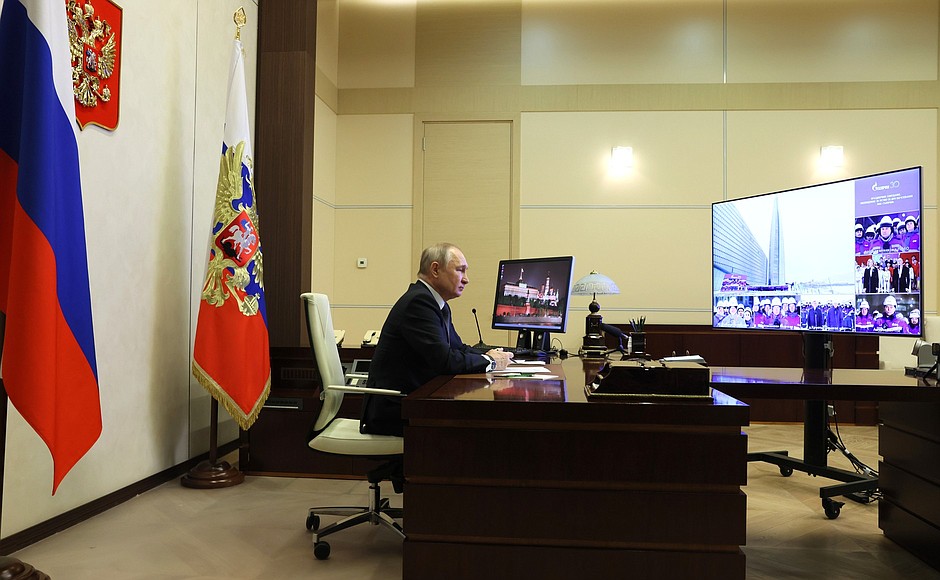
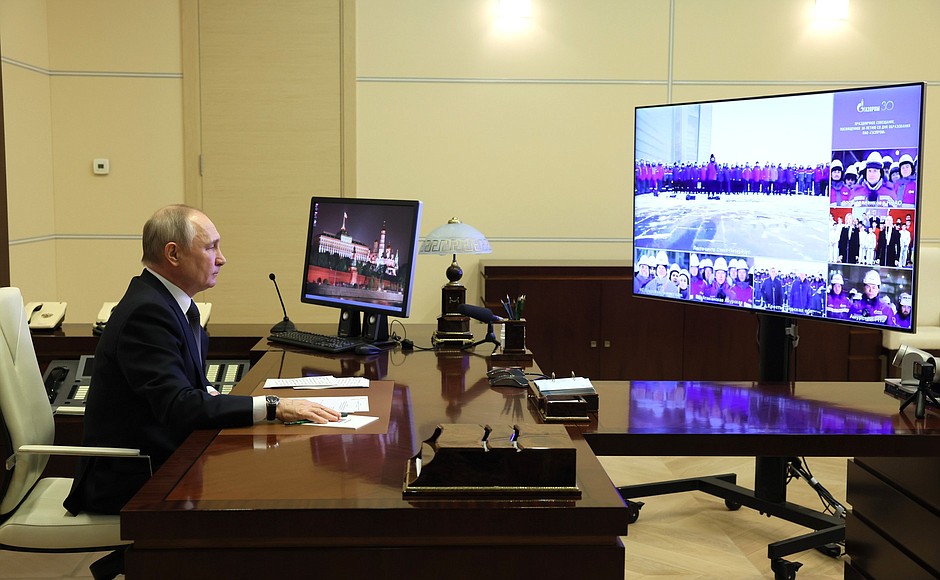
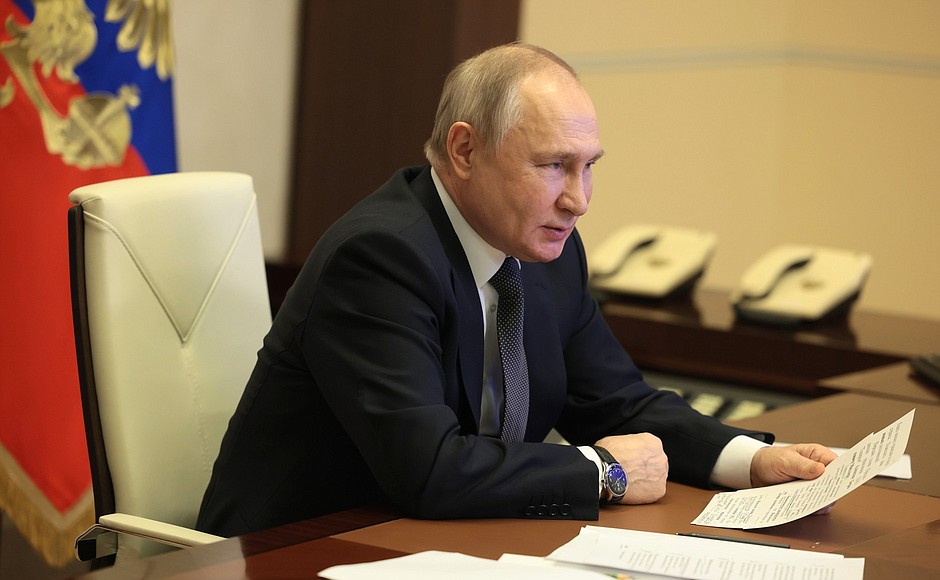
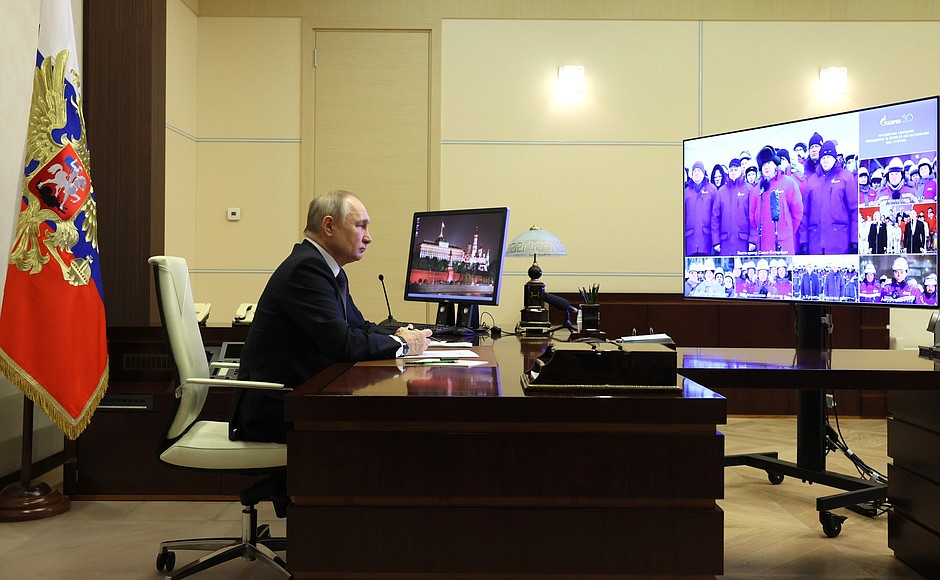
President of Russia Vladimir Putin: Colleagues, good afternoon.
Gazprom CEO Alexei Miller: Good afternoon, Mr President.
Vladimir Putin: Hello.
Not too cold, Mr Miller?
Alexei Miller: No, everything is fine.
Vladimir Putin: Is it cold where you are? What is the temperature?
Alexei Miller: About minus 5 degrees Celsius, but the wind is blowing from the gulf.
Vladimir Putin: I see.
Today, we are marking the 30th anniversary of Gazprom, a world-famous Russian company. It is one of Russia’s largest and most advanced corporations, as well as a global leader in terms of natural gas reserves, output, and supplies.
I am glad to convey to you my best wishes on this anniversary and congratulate all Gazprom staff members, who are almost half a million-strong (over 490,000): workers, engineers, geologists, drillers, construction workers, and people representing dozens of other crafts and trades. They are all top professionals, and the whole country is proud of you.
Of course, today we must send our warmest greetings and best wishes to the Russian gas industry veterans. They were the ones who laid the foundations and started developing vast and unique deposits, built entire cities and towns, and laid energy supply routes of international significance.
Gazprom was incorporated as an independent company in the early 1990s, which was a difficult period for the country, and the decision to preserve it as a single and integrated whole turned out to be strategically correct. Gazprom began to grow and has been a trailblazer for other industries and entire regions with their social infrastructure ever since, promoting Russia's economic revival and growth.
Today, Gazprom remains a responsible, efficient and sustainable business. Despite the frankly unfair competition and direct attempts to halt and curb its development from the outside, Gazprom is moving forward and launching new projects, including by carrying out geological prospecting surveys, producing gas and ensuring its advanced processing, as well as taking part in building the Northern Latitudinal Railway and other transport infrastructure facilities.
I must also note that Gazprom creates orders for Russian high-tech businesses, including SMEs and young researchers’ teams.
Of course, Gazprom has a solid track record of paying special attention to carrying out major social and humanitarian projects by supporting cultural, educational and environmental programmes, building housing and schools, helping equip hospitals and improve and develop streets, embankments and parks.
For example, over 2,000 sports centres, sports grounds and school stadiums have been built across Russia as part of the Gazprom for Children programme, which I believe was launched around 2007 (Mr Miller will correct me if I am wrong).
Gazprom is investing substantial funds in the comprehensive development of our cities, rural areas and regions, and it is doing the right thing. I would like to thank its management, shareholders and all workers for that.
It is notable that Gazprom’s perspective plans always look ahead and are designed for years and even decades to come, clearly, because of the long implementation cycle of your projects, which fully meets our national interests, and the goals and priorities of Russia as a major power and a sovereign centre of the multipolar world.
Gazprom's specific goals and new projects are based on detailed expert analysis and projected changes and trends in global markets. According to those forecasts and opinions, natural gas will remain an extremely valuable natural resource, a true asset it has been for years, and the demand for it will only grow.
Over the past 30 years, global natural gas consumption has almost doubled; in the next 20 years, according to expert estimates, it will add at least another 20 percent, and maybe more. In the so-called transition period, the demand will be enormous. Moreover, the Asia-Pacific region will account for more than half of projected growth, primarily the People’s Republic of China, given the high pace of its economic growth.
In this context, the further development of the huge gas industry network created in the east of our country is becoming strategically important for Russia. This network includes the Yakutia and Irkutsk gas production centres, the Amur Gas Processing Plant, which is under construction, and the Power of Siberia gas pipeline, which was connected to new reserves with the launch of the Kovykta gas condensate field into commercial operation last December.
Overall, as far as international cooperation and export contracts are concerned, Gazprom is facing monumental challenges, having to rearrange its logistics routes and gain a foothold in new markets. Yesterday alone, I think Mr Miller and I spent about two hours discussing all these plans with our potential partners.
Let me emphasise that no matter how important international trade is, what matters the most to us is promoting our national development, providing for reliable, steady economic growth, shielding the national economy from any threats, and ensuring uninterrupted supplies for our enterprises and regions. Of course, this also includes improving the quality of life for people across all regions of Russia.
I believe the expanded programme of social gasification, when connection to gas distribution networks is brought right up to the land plot boundary, is one of the most important projects for Gazprom in terms of its social responsibility. Starting this year, the programme has no expiration date. In addition, it now covers social infrastructure, educational and medical institutions, as well as housing.
Let me remind you that certain categories of people can benefit from additional support. This includes families with many children and combat veterans. I am referring to subsidies people can obtain when buying services and gas equipment for their homes. We have already allocated federal funding to this effect, and I am asking you to always keep a close eye on these efforts.
We planned several link-ups for this event with Gazprom sites across the country, from the Baltic Sea to Russia’s Far East.
But before that, I would like to once again congratulate Gazprom workers on the company’s anniversary and thank you for your great work for the benefit of our people and our vast country and wish you every success in your undertakings.
I will now pass the floor to Gazprom CEO Alexei Miller.
Mr Miller, go ahead, please.
Alexei Miller: Mr President,
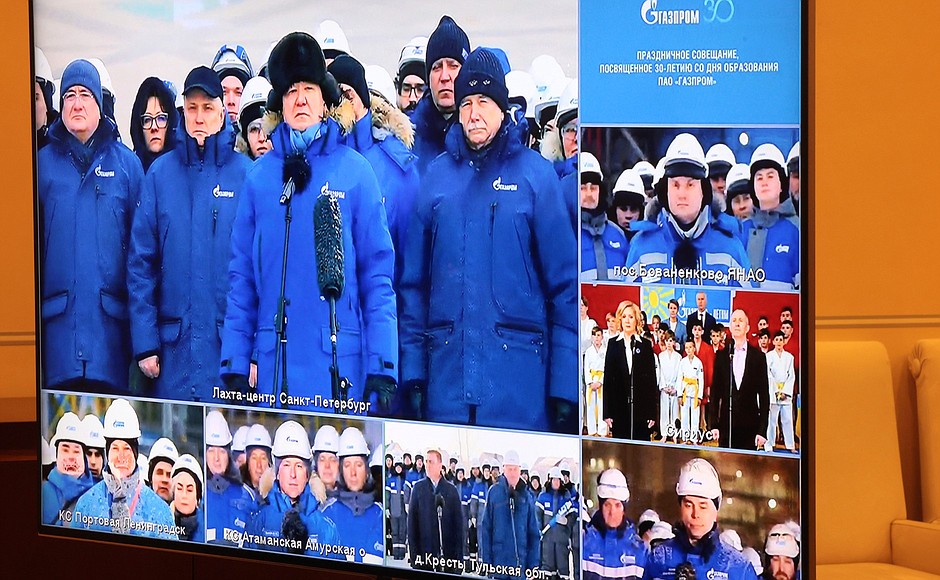
We are in the Lakhta Centre in St Petersburg.
Gazprom headquarters is located in the Lakhta Centre, from which we manage the unified gas supply system in Russia, from Petropavlovsk in Kamchatka to Kaliningrad, across all time zones.
During the autumn and winter seasons, when it is especially, intensely cold, Gazprom reliably and stably provides gas to its customers in the power sector, in industry and to the people, of course.
Gazprom is implementing unique projects, which constitute the backbone of Russia’s gas sector in the 21st century.
Today, Gazprom is a leader in the global energy market and the largest company in the country ensuring comprehensive power supply in Central Russia and providing not only gas but also electricity and heating to our customers.
We have unrivalled expertise in working in the Arctic, unique competencies, experience and knowledge. Gazprom has created a new gas production centre on the Yamal Peninsula. We are developing new large hydrocarbon fields. I can tell you, with good reason, that Russia is doing more in the Arctic than anyone else. We have no rivals in the Arctic.
We are also working successfully in the East. Mr President, you recently launched the Kovykta gas condensate field and the second phase of the Power of Siberia gas pipeline into commercial operation. The pipeline is now operational throughout its entire length, which is about 3,000 kilometres.
The Kovykta and Chayanda fields, the largest in Eastern Siberia, are multi-component fields, which is why we are building the Amur Gas Processing Plant to supply products to the gas chemical industry.
Gazprom is developing main transport in all regions of the country. At present, we are preparing to build the Power of Siberia 2 gas pipeline, the Soyuz Vostok gas trunkline via Mongolia, the Far Eastern gas pipeline and, of course, a link to connect our gas transport network in the European part of Russia to the gas transport systems we have created under the Eastern Gas Programme.
The main pipeline transport is the backbone of the further development of the gas supply and connection system. Providing gas supply in rural areas means, first of all, higher quality of life there, while higher rate of gas infrastructure development in the regions creates new opportunities for agriculture and industry.
We can assure our customers that there is enough gas in Russia for decades to come. This conviction is based on the world’s largest resource portfolio.
The flagship of production is the Yamal gas production centre and its heart is the Bovanenkovskoye field. We will give the floor to Bovanenkovo.
General Director of Gazprom Dobycha Nadym Dmitry Shchegolev: Mr President, Mr Miller,
I am at the Bovanenkovo oil and gas condensate deposit on the Yamal Peninsula.
We began extraction here in 2012. Since then, we have put three gas fields into service and have reached design capacity. Now we can produce over 100 billion cubic metres of gas a year. We are increasing the number of gas production wells every year and now 595 out of 770 project wells are operating.
Simultaneously, with the upgrades at Bovanenkovo, we are preparing to launch the operations at the Kharasaveyskoye deposit, which is a little over 100 kilometres to the northwest of here.
Today, 100 natural gas wells out of the 167 project wells have been drilled. Construction is underway on a gas treatment plant, a booster compressor station and the Kharasavey-Borovenkovo connecting gas pipeline.
We are planning to start industrial gas production at Kharasavey in 2024, which will add another 32 billion cubic metres of gas annually to Gazprom’s balance sheet.
Today, about 3,000 Gazprom employees are working at Borovenkovo. Another thousand will work in shifts at the Kharasaveyskoye deposit. Climate conditions are severe, but we try to make up for this by creating good living conditions for our employees. They have a modern shift complex, gyms, cafeterias, a swimming pool and a concert hall.
Gazprom’s 30th anniversary is an important event for our team. Working at Gazprom is an honourable and responsible profession. We are confident that the company has a great and glorious future.
Alexei Miller: Mr President,
Gas from Bovanenkovo is sent to the Vyborg area where Gazprom has built a gas liquefication plant. We are developing our own competences in liquefication technology and gaining our own experience. I am giving the floor to the team at Gazprom SPG Portovaya.
General Director of Gazprom SPG Portovaya Anton Stukov: We are at the LNG production, storage and shipping facility. The company is located on the northeast coast of the Gulf of Finland.
Our plant can produce 1.5 million tonnes of LNG per year. The complex was launched in September last year. By now it has already produced over half a million tonnes of LNG.
The plant is connected to Russia’s unified gas distribution system. The gas is first processed at the plant and is then sent to the liquefication station. Two shops with Ladoga gas turbines compress the refrigerant. The temperature of LNG is about minus 160C. It is used by the public transport system in St Petersburg. We use a floating depot – the Portovy tank vessel – which can tranship LNG to gas-carrier vessels.
Our main goal here is to ensure independent and autonomous natural gas supply to Kaliningrad. Mr President, you set this goal for us, and it has been successfully carried out.
Colleagues, each of us wants to work with maximum dedication and full responsibility. Like thousands of Gazprom employees, we are doing all we can to ensure national energy security.
Alexei Miller: Mr President,
An unparalleled natural gas complex, which includes production, transport and processing facilities, has been created in Eastern Siberia. These facilities are connected by an unmatched and the world’s most modern, gas pipeline, the Power of Siberia. With that, I turn it over to Gazprom Transgaz Tomsk company.
Director General of Gazprom Transgaz Tomsk Vladislav Borodin: We are at the Atamanskaya compressor station of the Power of Siberia gas pipeline. I have workers, engineers and executives here who are making sure the gas pipeline operates reliably.
The Power of Siberia has been under construction since 2014 in these extreme natural and climatic conditions. The pipes were laid through mountainous and seismic zones, permafrost and rocky soils.
Today, the Power of Siberia offers new opportunities for gas infrastructure development in eastern Russia for decades ahead. Natural gas is now being supplied to boiler houses and production facilities, including the Vostochny Cosmodrome.
We plan to ramp up the gas pipeline’s export capacity as well. To do so, second shops at seven compressor stations will be put into operation. They have been named after the trailblazers who came to Siberia in the 17th century. The capacity of the eighth station, Atamanskaya CU where we are now, will have almost doubled by the end of this year from 128 to 224 megawatts.
Our company is working for the good of the country, and our success is the success of every Russian citizen. Together, we are a powerful force. We are the Power of Siberia, the power of Gazprom, and the power of Russia.
Alexei Miller: Mr President,
Eastern Siberia has multicomponent gas, which is why Gazprom is building gas processing facilities in this region in order to supply processed products to other high-tech industries.
I turn the floor over to the Amur Gas Processing Plant.
Director General of Gazprom Pererabotka Blagoveshchensk Yury Lebedev: After reaching full capacity, the Amur GPP will process 42 billion cubic metres of gas per year.
Our plant is the basis for forming a large gas chemical cluster in the Amur Region. The Amur GPP products – ethane, propane, butane and pentane-hexane – will be used to make polyethylene, polypropylene, various plastics, construction materials, motor fuels and other products that are widely used in our country’s economy and abroad.
Helium is a rare gas that our plant will produce in large quantities. It is used by high-tech industries, such as instrument making, aerospace, electronics and medicine.
A gas chemical complex is being built next to the plant, which is technologically and infrastructurally connected with our enterprise.
The best specialists from all over the country are moving to the town of Svobodny to build and then operate the Amur GPP. A workforce with unique competencies is being formed here.
Our plant is a modern automated production facility as well.
Our company has 2,500 employees that operate the plant. At full capacity, the team will include 3,200 specialists. The experience and knowledge that workers and engineers gain here will make it possible to expand the processing industry and to introduce the latest technology which will reliably provide Russia with gas and gas products in the 21st century.
Alexander Miller: Mr President,
Undoubtedly, Gazprom’s main social programme is further developing gas infrastructure and increasing the number of buildings connected to it.
Without doubt, providing gas supply in rural areas means a new quality of life, while expanding gas supply and further developing gas infrastructure in the regions means creating new opportunities for the development of agriculture and industry in these regions.
Next we will hear from the Tula Region.
General Director of Gazprom Mezhregiongaz Sergei Gustov: Good afternoon,
Mr President, Mr Miller, colleagues,
Today Gazprom is implementing a gas supply and gas infrastructure development programme in 72 Russian regions. By 2025, gas will again come to 4,500 cities, towns and villages in our country. The programme is being implemented in full.
In line with your instruction, Mr President, the end of 2021 in Russia saw the start of construction of gas pipelines at the expense of Gazprom up to applicants’ land plot boundary. In 2022 alone, we provided gas to 504,000 households. And this is a programme that has material, technical and financial resources. Everything that is necessary for gas supply and grid connection is produced in our country in sufficient quantity and of excellent quality.
Thank you, Mr President, for your attention and support of this large-scale programme implemented by Gazprom. Gazprom, the United Russia party, the Russian Government, the Federation Council and the State Duma are working together to complete the task before us.
New households are getting access to gas supply, as well as industrial, farming, and social facilities. Today Tula Region Governor Alexei Dyumin and I will open a new pipeline that will provide gas to 300 households, which means that people will feel comfortable, cosy and warm, and save on heating.
The most important thing is to fulfil the task that you have set, Mr President: to expand gas access in the country to the full extent technically possible.
I congratulate you, colleagues, on the 30th anniversary of our company.
And now I give the floor to Tula Region Governor Alexei Dyumin.
Governor of the Tula Region Alexei Dyumin: Good afternoon, Mr President, Mr Miller,
Allow me to join the greetings and congratulate the management and industry personnel on this anniversary, and to thank you for working hard to supply gas to our region. This provides completely new opportunities for resolving problems and developing the region in various areas, but the most important and key thing, our priority is our peoples’ comfort.
In August 2020, in the Hero City of Tula, Mr Miller and I signed a programme for the further gas infrastructure development in our region through to 2025, which provides for connecting 363 towns in our region to gas grids. In line with your instruction on social gasification – this is fully underway in the region, this programme is in demand and appreciated by residents: 7,000 contracts have already been signed, gas connection has been brought up to the boundaries of 3,500 land plots and households. Also, under this programme, we plan to supply gas to another 17,000 households.
Mr President, in line with your instructions, we have also developed and are implementing regional support for 13 categories of persons entitled to benefits – subsidies that amount to 120,000 rubles each.
Separately, I would like to stop and once again thank Mr Miller personally, as well as the entire management of the company for their active – you spoke about this, Mr President – participation in the social life of our region.
In the past seven years, Gazprom has built two sports and recreation complexes and 67 multifunctional sports grounds in the Tula Region, where residents enjoy spending time, both in summer and in winter. A large ice palace opened, which gave a boost to the development of ice hockey in our region, and there are already two youth teams and a VHL team that has had good results. In addition, the construction of a multifunctional indoor track continues, which, after opening, will host competitions at the highest level, both national and international.
Mr President, everything that has already been implemented, and the plans and goals that we face, which we will implement, would not be possible without your personal participation and without the instructions that you have given. Thank you very much, personally, for your attention to this area, Mr Miller for your participation in the development of our region.
Mr Miller, I would like to take this opportunity to inform you that today I have signed an appeal addressed to you with an additional request for the construction of multifunctional sports grounds, which the residents in remote towns and municipalities are waiting for. I am sure that on this festive day – Gazprom: Dreams Come True! – the decision will be positive, and in the near future we will already see positive results.
Once again, I congratulate your staff and all the management on this anniversary.
Mr President, thank you very much. This concludes my report.
Alexey Miller: Mr President,
Traditionally, when gas comes to a town, we ignite the ceremonial control torch.
I ask you to give permission to ignite the control torch.
Vladimir Putin: Please, yes, of course.
(Ceremonial ignition of a gas torch in the village of Kresty, Tula Region, now with a gas connection.)
Alexei Miller: Mr President,
Gazprom is a socially responsible company, and, as you noted, we have been implementing the Gazprom for Children programme since 2007. Over 2,000 sports facilities have been built in 74 regions of the Russian Federation, of which 202 are sports and recreation centres.
A month ago we opened the Academy of Martial Arts in Sochi. I’ll now pass the floor to Sirius.
Gazprom Management Board member Yelena Mikhailova: Last year, 70 different facilities were opened as part of the Gazprom for Children project: 19 sports and recreation centres and 46 plate structures were built, five facilities were upgraded. A breakthrough was made in the Far Eastern Federal District, with seven sports and recreation centres built and one upgraded.
Today we are at the new Academy of Martial Arts, which will become home to athletes practising judo and sambo, from kids to Russia’s national teams and our famous Olympic champions. This is a big, modern world-class sports centre with an area of 63,500 square metres. It was built according to the highest standards in record time – 30 months.
Our unique centre has two training halls, a hotel for athletes, a hydrothermal complex with a swimming pool, and a medical rehabilitation centre.
Also in Olympic Park, we refurbished the Ice Cube and built a sports centre for hosting competitions, which has a unique hall with stands, rooms for athletes and referee teams, and a media centre.
We wish our athletes success and new great victories. Together we are building a healthy future for our nation. Hurray!
I am giving the floor to President of the Russian Judo Federation Sergei Soloveichik.
President of the Russian Judo Federation Sergei Soloveichik: On behalf of the Russian judo family, I would like to thank you, Mr President, the Government of the Russian Federation, Gazprom, and the leadership of the Sirius federal territory for this gift we need so much. We have always dreamed of our own home, and thanks to your support, the first training session will take place today on the tatami of the Academy of Martial Arts.
At the Academy of Martial Arts, the best Russian judokas will improve their skills in order to perform well at the world’s major competitions.
Along with the training of national teams, the new academy will hone our priority programmes, Preschool Judo, School Judo, and Family Judo, which we developed together with specialists from the Ministry of Education and the Sirius federal territory. Thanks to these programmes, hundreds of thousands of children in our country will receive physical, spiritual and, most importantly, patriotic education on the tatami, and will become upstanding citizens of Russia.
Thank you.
Alexei Miller: Mr President,
The Lakhta Centre provides extensive space for hosting sites of the Gazprom for Children programme. These are sites for creative, sports, and intellectual development. A state-of-the-art planetarium and a large educational and leisure centre for children and youngsters, where they can gain new knowledge and new skills, will be opened at the Lakhta Centre. Without a doubt, the Gazprom for Children programme is a great contribution to the future of Russia.
Colleagues,
Congratulations on the 30th anniversary of Gazprom. And, as we say at Gazprom, “and now back to work!”
Vladimir Putin: Mr Miller, colleagues, friends,
We have just mentioned some facilities that Gazprom has built or is already operating, implementing them in part and drafting its development plans in general. However, this is far from all that Gazprom has and what it is doing. This is simply a small sample of its activities.
But even if we return to what our colleagues were talking about now, the Bovanenkovo and Kharasavey fields, we will recall that the first one has 4.9 trillion – almost 5 trillion cubic metres of proven reserves. The corresponding figure for the second one is about 2 trillion cubic metres. These are astronomical reserves for any country. I won’t even mention at this point Grazprom’s other capacities that are simply incommensurable with any other gas-producing country in the world. These are tremendous reserves.
Let’s look at the LNG plant with a project capacity of 1.5 million tonnes of LNG per year. Here’s something I noted during the report made on this facility. It has the Ladoga compressor station of domestic make. We know that in the past the company depended on foreign producers in this area of its work. Partly this dependence still remains to this day.
Gazprom is a contractor for our power engineering companies. Considering our competences and education of our engineers and scientists, orders by Gazprom – the anchor contractor that will be joined by others – will promote the development of domestic power engineering. Gazprom is also playing an important role in this respect. This is just one of the areas in which we are seeing the synergy of Gazprom’s work with related companies.
I mentioned related companies but synergy also exists in other areas. Our colleague reported about the Atamanskaya compressor station in the Amur Region and mentioned in passing gas supplies to the Vostochny Cosmodrome. But listen – in one instance this is a large, important project for the county and in another, it is the development of the space industry. It would seem gas supplies don’t matter that much… But they drastically change the capacities of the Vostochny Cosmodrome, its civilian component. The economics of the entire enterprise, the cosmodrome, is undergoing a dramatic change, providing Russia with additional opportunities for developing its space industry as well. It is perfectly obvious that this is being done with Gazprom’s support in this case.
Or take the Amur Gas Processing Plant. Of course, as one of the world’s largest gas producers, Gazprom should do and is doing this – it is gradually developing gas processing, gas-to-chemicals in this case. It is abundantly clear that this is the future, just like the processing of other energy resources, including oil and coal. And this is also a very important, serious area of Gazprom’s development.
We have cited an example of Gazprom’s major national effort to develop gas infrastructure. We have heard some analysts and economists say that this is a low-margin project that will not generate much revenue for Gazprom. Nevertheless, I believe Gazprom is doing the right thing in developing these programmes because it creates a market for the future, and material progress – supplying gas to households is definitely beneficial for the well-being of Russian families – growth of the material well-being creates future consumers in many aspects.
In this regard, I would like to mention supplying the Russian economy with natural gas motor fuel for transport, households, and passenger vehicles, which is important, and I want you – the leaders of the regions will certainly hear us – to focus on this.
By the same token, social programmes such as Gazprom for Children, Gazprom is running quite a few of them in Russia, serve the same purpose of strengthening the future market. Developing the public health and fitness, and recreation sector, is all about working for our people and your current and future consumers. In addition to socio-political, domestic political dimension, it clearly has an economic dimension.
I would also like to thank you for the wrestling, judo and sambo facility which was most recently built under the Gazprom for Children programme. I am sure it was built to the highest standards.
Mr Miller, we agreed some time ago that we would tour that facility in person. I can see that you are wearing your hat like Nightingale the Robber, which once again shows some of your personality. So, as agreed, let’s – even though you have never done any of these sports – let’s step on the tatami in this excellent facility together with the children who are practising there today and see how it works.
As for the Lakhta Centre, the construction of which you spearheaded, I believe it will be put to good use by Gazprom and everyone who lives nearby, since Lakhta Centre has much to offer potential customers. This is a 462-metre high building, the tallest in Europe. I am sure Gazprom will remain at a similarly high position too.
I wish you a happy anniversary and every success.
Best wishes.